
API and API Keys
The web interface talks to a set of JSON endpoints under /api. With an API key you can call the same endpoints from scripts, CI pipelines and workflow tools such as n8n, without a browser session.
Create a key
- Sign in and open the Configuration page, then the Authentication tab.
- In the API Keys card click Create key, give it a name that tells you where it is used, and pick an expiry: never, 30 days, 90 days or a year.
- Copy the key. It is shown once; afterwards only its first characters are visible in the list.
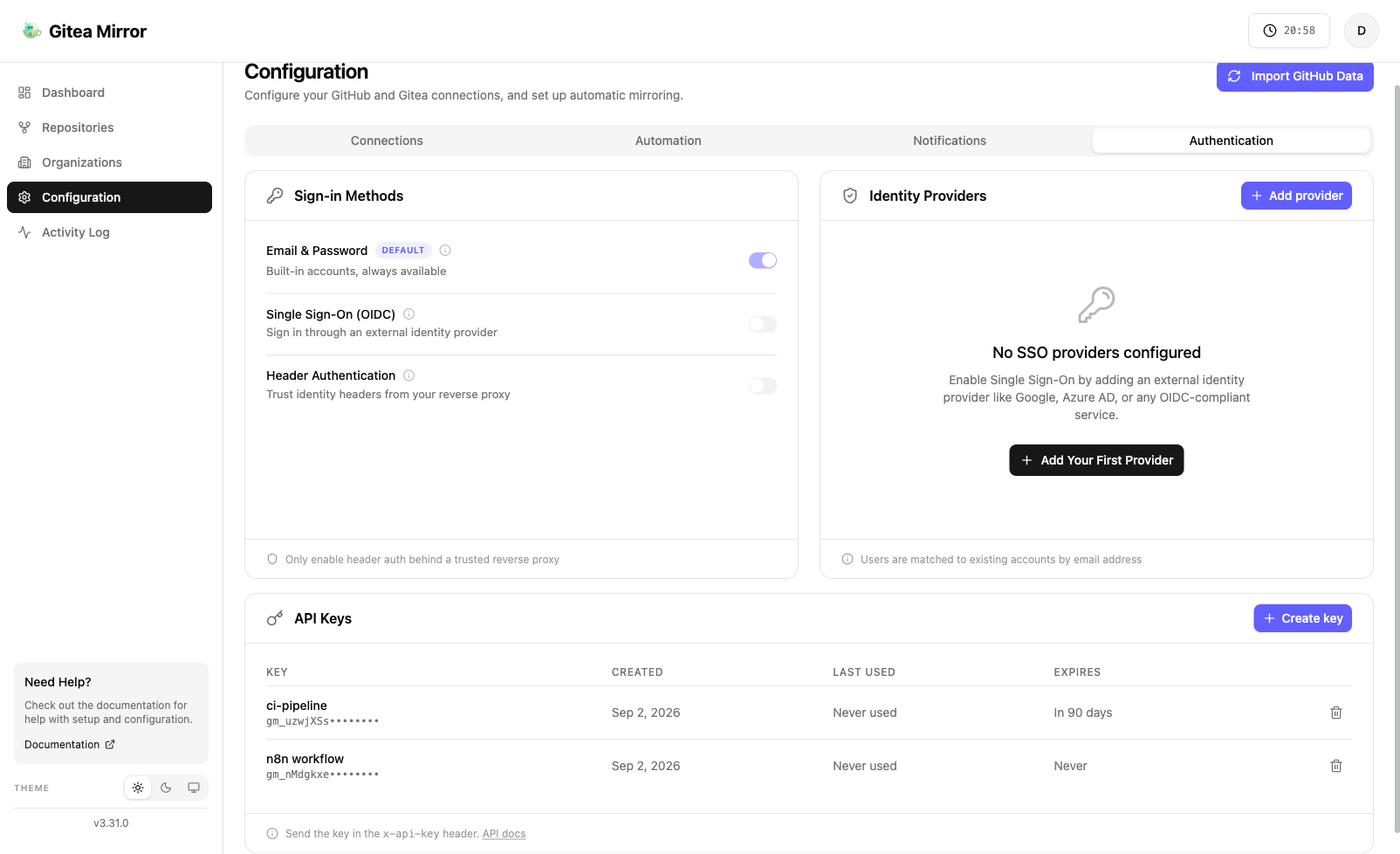
Keys start with gm_, belong to the user who created them and carry the same rights as that user’s session. Revoke a key from the same list at any time. Keys are stored hashed. They are not rate limited by the app, so a runaway script is stopped by revoking its key.
Send the key
Put the key in the x-api-key header. Every endpoint that accepts a session cookie accepts the header instead.
curl -sS "https://mirror.example.com/api/github/repositories" \
  -H "x-api-key: gm_..."
A missing, malformed, expired or revoked key gets 401 Unauthorized:
{ "success": false, "error": "Unauthorized" }If the app is served under a path prefix (BASE_URL=/mirror), prefix every URL with it: /mirror/api/....
Endpoints
The calls below cover the common automation cases. Response bodies show the fields you are most likely to use; the app returns more.
Health
GET /api/health needs no key. It reports overall status, database connectivity and the recovery state, and is what the container health check polls. The full response is described in Advanced topics.
List tracked repositories
GET /api/github/repositories
Despite the name it lists every repository the account tracks, whatever the configured source. Requires a saved configuration, otherwise 404.
{
  "success": true,
  "message": "Repositories fetched successfully",
  "repositories": [
    {
      "id": "9b2f...",
      "name": "hello-world",
      "fullName": "octocat/hello-world",
      "owner": "octocat",
      "organization": null,
      "status": "mirrored",
      "mirroredLocation": "github-mirrors/hello-world",
      "lastMirrored": "2026-09-02T08:00:00.000Z",
      "errorMessage": null,
      "destinationOrg": null,
      "sourceProvider": "github",
      "isPrivate": false
    }
  ]
}
status is one of imported, mirroring, mirrored, failed, syncing, synced, skipped, deleted, archived.
Add a repository
POST /api/sync/repository
{ "owner": "octocat", "repo": "hello-world" }Optional fields: destinationOrg to override the destination organization for this repository, and force: true to refresh the metadata of a repository that is already tracked.
The repository is looked up on the configured source and added with status imported. It is not mirrored until you start a mirror (next call) or the scheduler picks it up.
| Status | Meaning |
|---|---|
200 |
Added. repository.id is what the mirror call needs. |
400 |
owner or repo missing. |
404 |
No configuration for this account, or the repository does not exist on the source. |
409 |
Already tracked. Send force: true to refresh it instead. |
Start a mirror
POST /api/job/mirror-repo
{ "repositoryIds": ["9b2f..."] }Starts mirroring in the background and returns straight away. Poll the list endpoint to watch status move from mirroring to mirrored or failed.
| Status | Meaning |
|---|---|
200 |
Job started. repositories lists what was queued. |
400 |
repositoryIds missing or empty, or no source token saved. |
404 |
None of the ids belong to this account. |
POST /api/job/sync-repo takes the same body and re-syncs repositories that are already mirrored.
Organizations
POST /api/sync/organization adds an organization or group the same way:
{ "org": "my-org", "role": "member" }role is the account’s role in that organization (member, admin, owner or billing_manager). 409 means it is already tracked; force: true refreshes it. Then POST /api/job/mirror-org with { "organizationIds": ["..."] } mirrors its repositories.
When several sources are connected, an optional sourceId picks which one the organization imports and mirrors from (the first connected source is the default):
{ "org": "my-org", "role": "member", "sourceId": "…" }PATCH /api/organizations/:id with { "sourceId": "…" } re-pins an existing organization to another source, and { "sourceId": null } clears the pin so the organization follows every source’s repositories of the same name again. A pin whose source was removed falls back the same way.
Run cleanup
POST /api/cleanup/trigger runs the repository cleanup now, with the account’s saved cleanup settings, and returns how many orphaned repositories were found and processed and any errors. GET /api/cleanup/trigger returns the cleanup configuration and the last and next run times.
Reconcile the destination
POST /api/cleanup/reconcile
Compares what the destination (Gitea or Forgejo) holds with the repositories this account tracks. See Cleanup and reconcile for what the groups mean.
{ "dryRun": true, "adoptUntracked": false, "resetMissing": false }The body is optional and every field defaults to the value above, so an empty POST is a dry run. With dryRun: false:
adoptUntracked: truecreates a row for each untracked mirror from its source URL, so scheduled sync and the cleanup service include it from then on. The row keeps the mirror where it is, even when the strategy would put it elsewhere.resetMissing: truesets each missing row back toimportedso the next mirror run recreates the mirror. Rows are never deleted.
Nothing is deleted or archived on either side by this call.
{
  "success": true,
  "dryRun": false,
  "report": {
    "untracked": [{ "location": "github-mirrors/hello-world", "originalUrl": "https://github.com/octocat/hello-world.git", "sourcePath": "octocat/hello-world", "isPrivate": false }],
    "missing": [{ "id": "9b2f...", "fullName": "octocat/gone", "location": "github-mirrors/gone" }],
    "notManaged": [{ "location": "me/notes", "reason": "not a mirror" }],
    "unverified": [],
    "healthyCount": 41,
    "elsewhereCount": 0,
    "scannedOwners": ["admin", "github-mirrors"],
    "skippedOwners": ["starred"],
    "totalOnDestination": 43
  },
  "applied": { "adopted": 1, "reset": 1, "skipped": 0 }
}
applied is null on a dry run. scannedOwners are the destination users and organizations that were listed; skippedOwners are ones the configuration or the database point at but the destination does not have. A row lands in unverified when the presence check itself failed, and is left alone. elsewhereCount counts rows mirrored to a previous destination, which are left out of the comparison.
| Status | Meaning |
|---|---|
200 |
Report computed, and applied when asked. |
400 |
A field has the wrong type, the destination is not configured yet, or the destination is a push target. |
404 |
No configuration for this account. |
A complete example
Add a repository and mirror it in one go:
#!/usr/bin/env bash
set -euo pipefail

BASE="https://mirror.example.com"
KEY="gm_..."

added=$(curl -sS -X POST "$BASE/api/sync/repository" \
  -H "x-api-key: $KEY" \
  -H "Content-Type: application/json" \
  -d '{"owner":"octocat","repo":"hello-world"}')

id=$(echo "$added" | jq -r '.repository.id')

curl -sS -X POST "$BASE/api/job/mirror-repo" \
  -H "x-api-key: $KEY" \
  -H "Content-Type: application/json" \
  -d "{\"repositoryIds\":[\"$id\"]}"
Managing keys from the API
Manage keys through the settings card or with a browser session. The key endpoints need a session cookie, not a key, so a leaked key cannot mint more keys. Like every cookie-authenticated POST to /api/auth/* they also need an Origin header; browsers send it on their own, a script must add Origin: https://mirror.example.com. The endpoints live under /api/auth/api-key/:
| Call | Body | Result |
|---|---|---|
POST /api/auth/api-key/create |
{ "name": "ci", "expiresIn": 2592000 } (expiresIn in seconds, omit for no expiry) |
The new key, including key, shown only here. |
GET /api/auth/api-key/list |
{ "apiKeys": [...], "total": n }. Each entry has id, name, start, createdAt, lastRequest and expiresAt, never the secret. |
|
POST /api/auth/api-key/delete |
{ "keyId": "..." } |
Revokes the key. |
Notes
- A key can only act on the account that created it. Each account keeps its own source, destination and repositories.
- Keys are not rate limited by the app. Source hosts still apply their own limits, and the app tracks GitHub’s.
- Deleting a user deletes their keys.